Insight
Smaller Teams,
Greater Impact.
How publishers and job boards can turn market knowledge into better recruiting outcomes with agentic AI.
The next opportunity for publishers does not end with a better job ad. It begins when local market knowledge and customer relationships become a better recruiting experience.
At Jobiqo Connect 2026, I opened with a story that seemed far from recruitment: a retired brewmaster using an AI agent to build a working system for his brewery. The interesting part was not the beer. It was what a small, experienced team could now build around its own work, without waiting for a conventional software project.
In his reflection on the event, Martin Lenz asked the right question for job platforms: how can publishers and job boards do more for employers and jobseekers with lean teams? He named a useful North Star: qualified applications.
Reach, ads and clicks still matter. They are means to an outcome that happens further along the journey.
What publishers already have
Regional and specialist job platforms are not starting from zero. They know their markets, have relationships with employers and reach people through trusted brands and channels. Their understanding of a region or sector can be deeper than that of a general platform.
That advantage becomes valuable when it helps at a specific moment: while an employer defines a role, when an ad is written, as a candidate weighs an opportunity, or when a campaign draws attention but too few relevant conversations.
The question is not how to produce more ads. It is how to help both sides reach a good conversation sooner.
Efficiency is a starting point
AI can speed up existing work. Teams can draft job ads, prepare channel variants, organize support requests and find internal knowledge faster. That is Efficiency AI: doing the current work with less time or cost.
Opportunity AI asks what service we would design if we could adapt software and intelligent support to the actual workflow. For a job platform, an employer briefing might no longer end with an ad. A system could reveal unclear requirements, help explain the role to candidates, answer questions during the application journey and learn from feedback. People would remain responsible for advice, quality and decisions. The technology would connect steps that are often separate today.
This is a design direction, not a claim about features already available on any particular platform. Nor is it an argument for automated hiring decisions.
The product begins before the click
If qualified applications are the measure, the whole journey matters:
- Understand the need. Which capabilities are essential? What can be learned on the job? What makes the role credible?
- Set expectations. Can candidates find the information they need to decide, including pay, working model and what happens next?
- Make applying easier. Where do suitable people leave because information is missing or the process is needlessly difficult?
- Learn from outcomes. Which signals from employers and candidates should improve the next briefing, ad and campaign?
These are not four features to add to a backlog. They are a better starting point for product discovery. The answers will differ by region, customer segment and platform. That is precisely where specialist providers can distinguish themselves.
The real constraint is Application Capacity
Coding agents lower the cost of understanding, building and changing specific software. Yet a promising prototype is still far from a dependable service. Teams need access to their processes and data, clear ownership, quality standards, safe integrations and short learning cycles.
We call the ability to turn accessible technology into changed work and better offers Application Capacity. This chart from my Jobiqo Connect keynote shows the problem schematically: technology advances quickly, while organizations usually change in steps. It is a conceptual model, not measured market data.
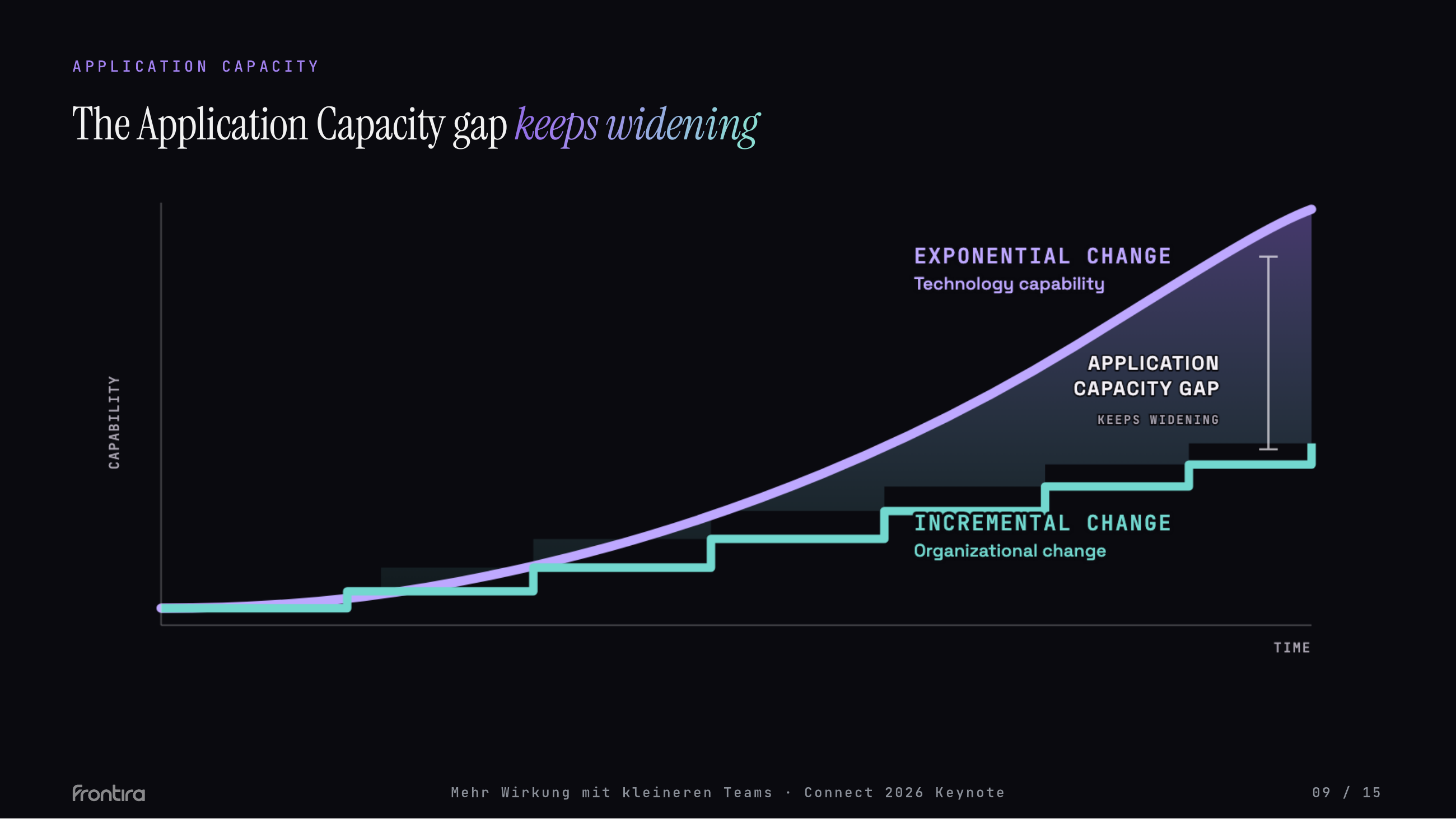
From the Jobiqo Connect keynote. Open the image for full size. The curves illustrate a capability gap; they are not quantitative forecasts.
As we explored in the article following my Linz keynote, lower software creation costs turn more workflows into possible use cases. For job platforms, the advantage will not come from having the longest AI ideas list. It will come from turning specific market knowledge into a useful, testable service.
What I would test next
I would choose one recurring customer workflow, perhaps from the first employer briefing to the initial application feedback. With an employer and the platform team, I would examine which information is missing, where people lose time and whether one small, carefully governed software component improves the experience.
The test is whether employers can define their needs more clearly, candidates can make better decisions and the team learns from real outcomes. A polished demo alone proves none of those things.
Smaller teams do not have to rebuild everything at once. They can start by turning the market knowledge they already possess into a service that goes beyond the ad. That is where AI becomes more than efficiency.
Stefan Erschwendner is Managing Partner at Frontira. This article develops ideas from his Jobiqo Connect 2026 keynote. It describes possible product directions, not announced Jobiqo features or results.